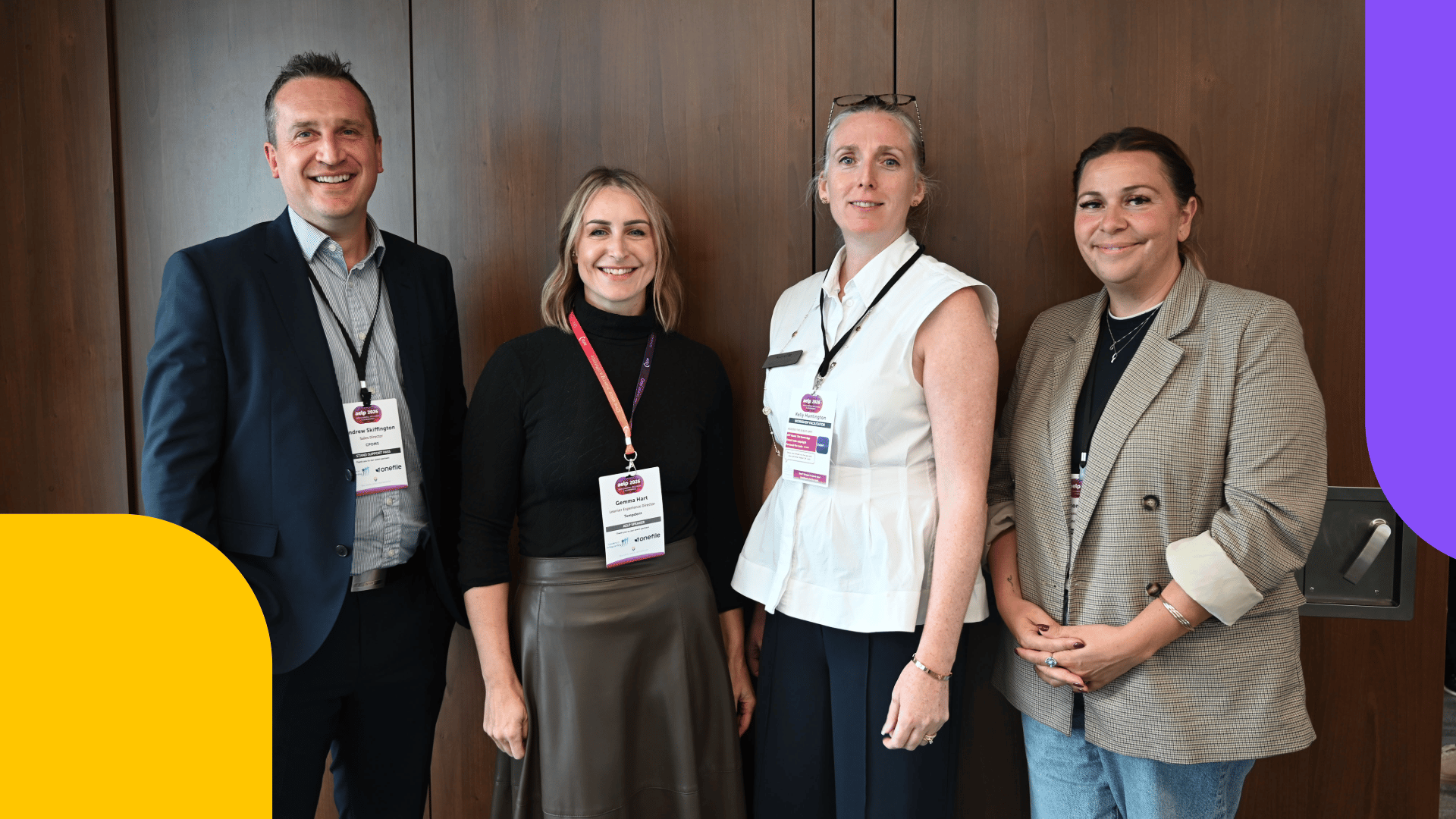
Safeguarding and inclusion should go hand in hand. In practice, they often sit in different teams, on different systems, with different people responsible for them. Our workshop at the AELP Safeguarding, Inclusion and Governance Summit put that gap in front of a panel and an audience of practitioners and asked what happens to the learner caught between the two.
Rather than presenting, we ran a panel discussion around two scenarios that everyone in the room recognised: the learner who quietly slips away, and the learner going through something serious who never says a word. What followed was one of the most candid sessions of the conference, and much of the best material came from the floor.
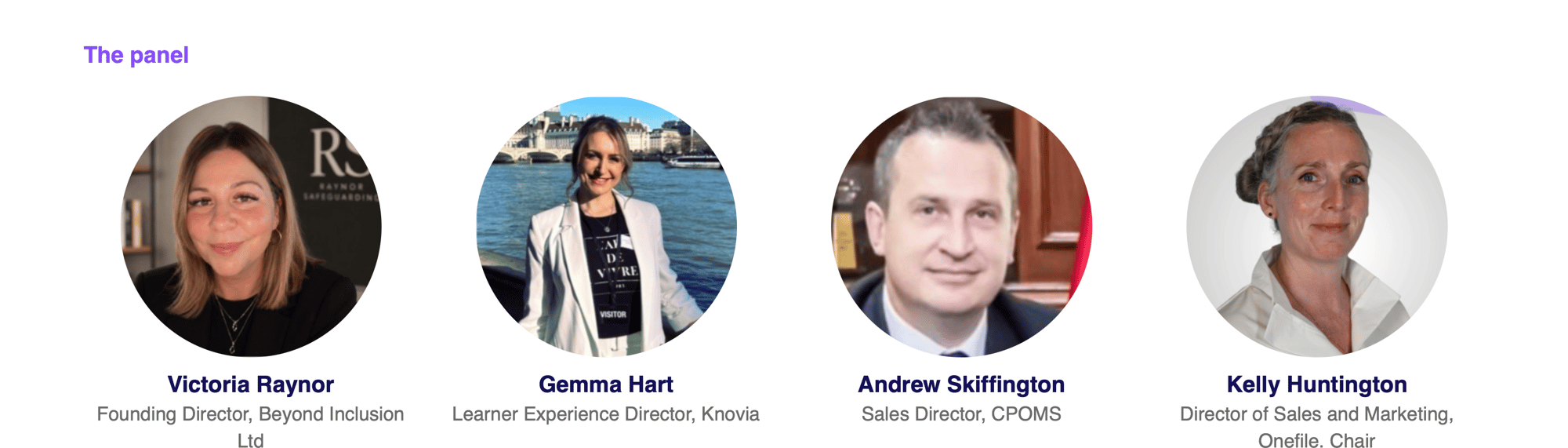
The first scenario described a learner quietly disengaging. Patchy attendance, gone quiet in sessions, work trailing off, and a lot going on beneath the surface. They might be a young carer, neurodivergent, the first in their family to reach further education, or struggling with their mental health. Nobody has raised it as a safeguarding concern.
Victoria Raynor's starting point was that certainty is not a prerequisite for action.
What both lenses depend on, she argued, is knowing the learner well. Before anything else, reflect on the journey that learner has had, and ask who in the organisation knows them best. There were a lot of unknowns in the scenario, so the first question is simply: what do we actually know? The discipline she returned to throughout the session was professional curiosity. Not what is wrong with this learner, but what might be happening to them, and what their journey is telling us about where they are now.
That reframes attendance entirely. Attendance is symptomatic of something else going on, an assuming a learner simply does not want to be there misses what is underneath it
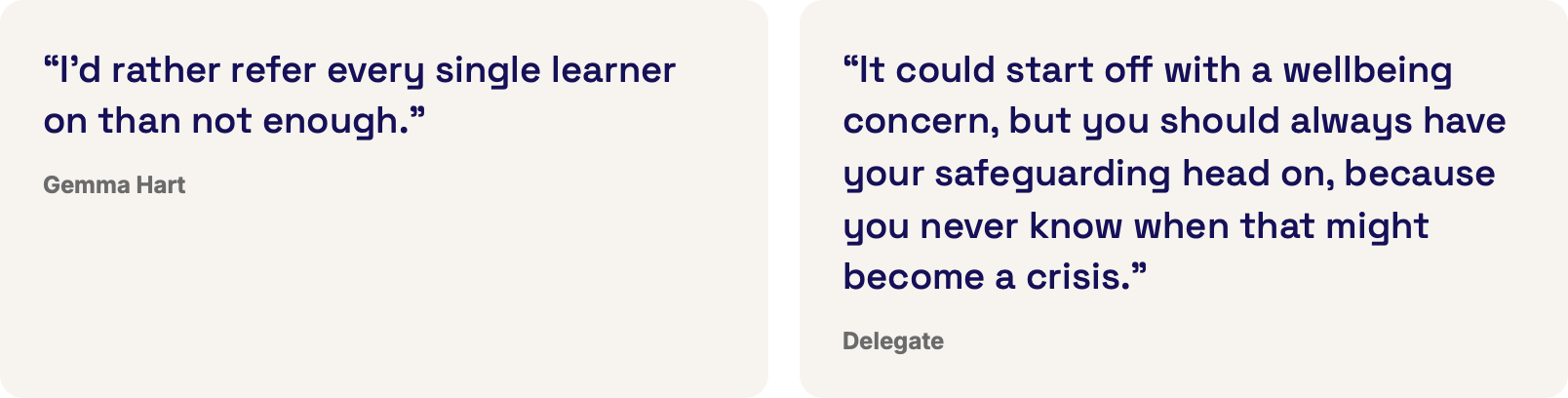
Gemma picked up the question practitioners find hardest: once you have noticed the signs and made your notes, when do you escalate? Is this a wellbeing issue you can hold yourself, or does it need to be referred on? Her advice was unambiguous. If you are unsure, refer it on. At worst, a few more people are aware of a concern
A learner with anxiety nobody is talking about may be self-harming, drinking, or taking other risks. If you cannot see how they are managing it within your own knowledge and support, that is the signal to refer. Every piece of information builds a picture, and recording it in one central place is what gives everyone oversight of it.
So Kelly Huntington put the workshop's title question to the room: where does safeguarding end and inclusion begin? The answers said the line does not really exist. One provider described combining the two from the start, so the tools are already in place if a wellbeing concern escalates. Another had built an inclusion checklist that runs from recruitment through SLT to tutor level, so the first time a tutor meets a learner they already know what has been flagged. It went live in May, ahead of an inspection in July where they were graded strongly on inclusion.
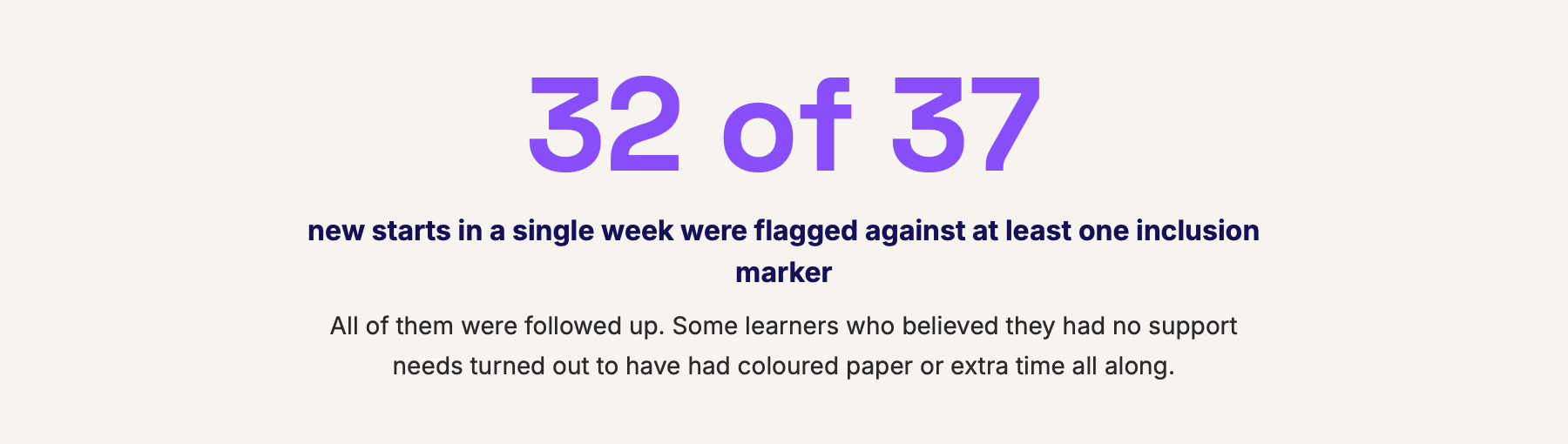
One benefit of asking early was immediate: their team is now in contact with a learner's social worker before the first lesson, rather than finding out months in. Transfer requests for prior records go in as soon as a learner discloses anything, and if the data has not arrived by the start date, professional curiosity means picking up the phone.
The sticking point
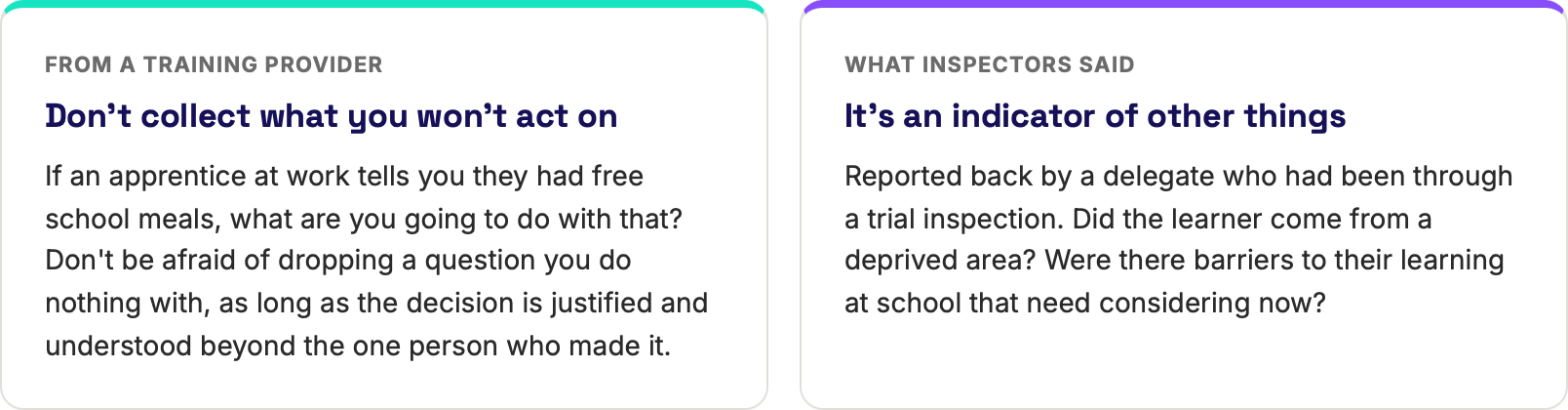
A training provider argued you shouldn't collect what you won't act on, while inspectors see it as an indicator of other things. Gemma Hart brought the two together with the risk of not asking.
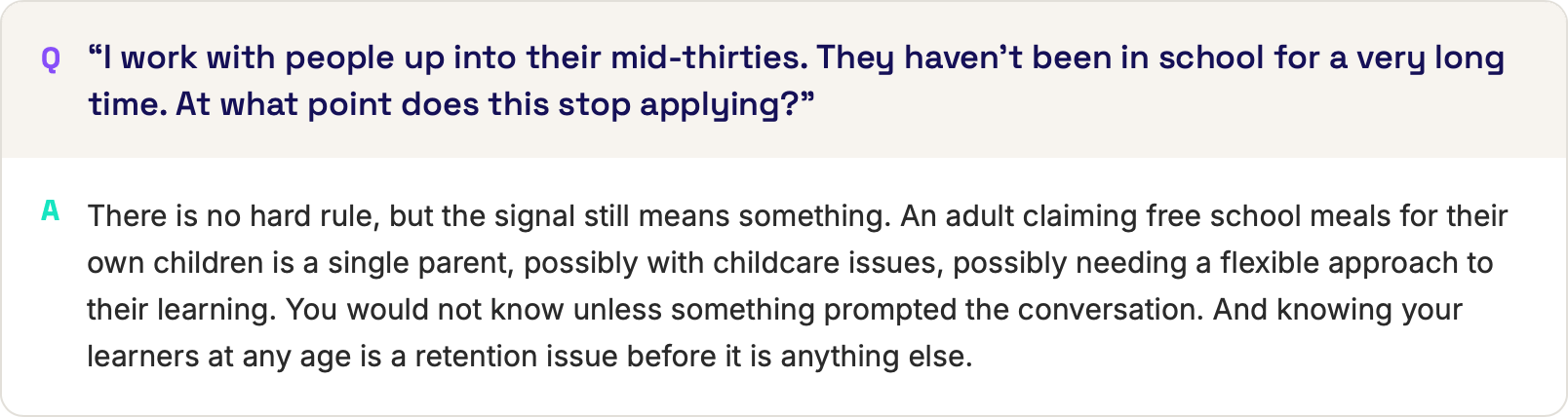
Victoria used that exchange to bring the conversation back to what safeguarding actually means, as distinct from child protection.
Research on adverse childhood experiences shows how far the effects reach into adulthood. Her conclusion was about timing: look at the information you already hold and ask what you can do with it preventatively, rather than waiting for something to reach a threshold where a referral becomes unavoidable.
A delegate added the dimension that applies to employed adult learners: belonging. If a learner has an unmet need, there is often real nervousness about their employer knowing. Building a relationship where there is a trusted person to speak to matters just as much at 60 as at 16, and she pointed out how easily staff forget that safeguarding covers them too.
The second scenario was harder. A learner is going through something serious and says nothing, because they do not feel safe to speak, do not trust anyone, and do not believe they will be heard rather than judged. How do you help them feel seen?
Andrew answered from experience, describing a student he taught in his second year as a lecturer who was living with abuse at home and was frightened of what telling the college would set in motion. Years later that student has a job, a family, and distance from all of it. What made the difference was sitting down with him and being open about exactly what safeguarding would and would not do.
Gemma raised something that sits underneath the whole scenario. When abuse is all a learner has ever known, they may not know it is wrong. Until someone teaches them what acceptable behaviour looks like, to receive and to give, there is no reason for them to identify it as something to report. That is why she argued for a wellbeing curriculum embedded in the vocation rather than bolted on, and for training the tutors and coaches who already have the relationships to deliver those sessions.
The technique she uses herself is reciprocity: sharing her own experience of how something felt, so that opening up is modelled rather than requested.

Victoria named the scenario for what it is: barriers to disclosure. Her first was psychological safety, which she defined as coming from knowledge rather than reassurance. A learner needs to know what happens to information once they share it, where it goes, who sees it and what follows. People often stay silent because they fear the situation will get worse. The culture that removes that fear says your information matters to us, and it is still your information.
Her second was a warning about structure. Good safeguarding teams can inadvertently create one visible person who appears to receive every disclosure. The culture worth building is one where anybody a learner works with is a safe person to tell, and the way to test it is to ask learners directly: if something were wrong, who would you actually go to? Then close the loop. You told us this was a barrier, and here is what we changed.

The first audience question was about adult learners who will not disclose a need such as dyslexia to their employer, for fear of being thought less of. The panel's position was that non-disclosure does not remove the provider's obligation. Build the rapport, encourage the learner towards sharing it themselves, and be honest that where employers are left guessing, they sometimes misread behaviour, timekeeping or organisation instead.
Meanwhile, the support goes in regardless. Gemma described telling the employer what has been adapted without ever naming a diagnosis. The employer needs oversight of the adaptations, particularly at inspection. They do not need the reason.
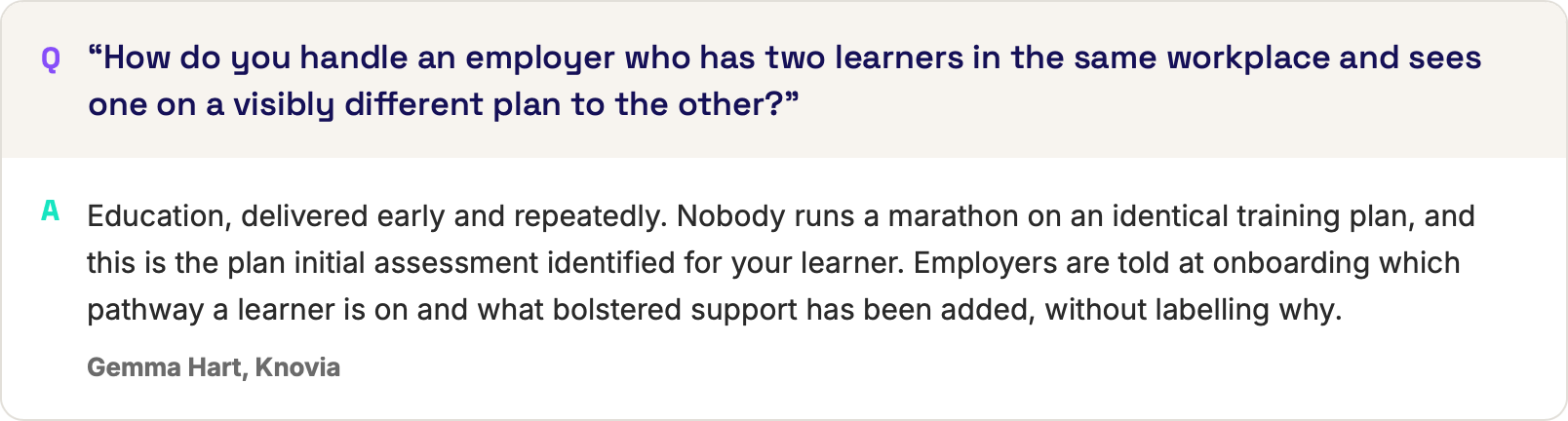


The last question came back to evidence: where are all these conversations kept, and are you ever asked to produce them? Three delegates answered from three very different positions.
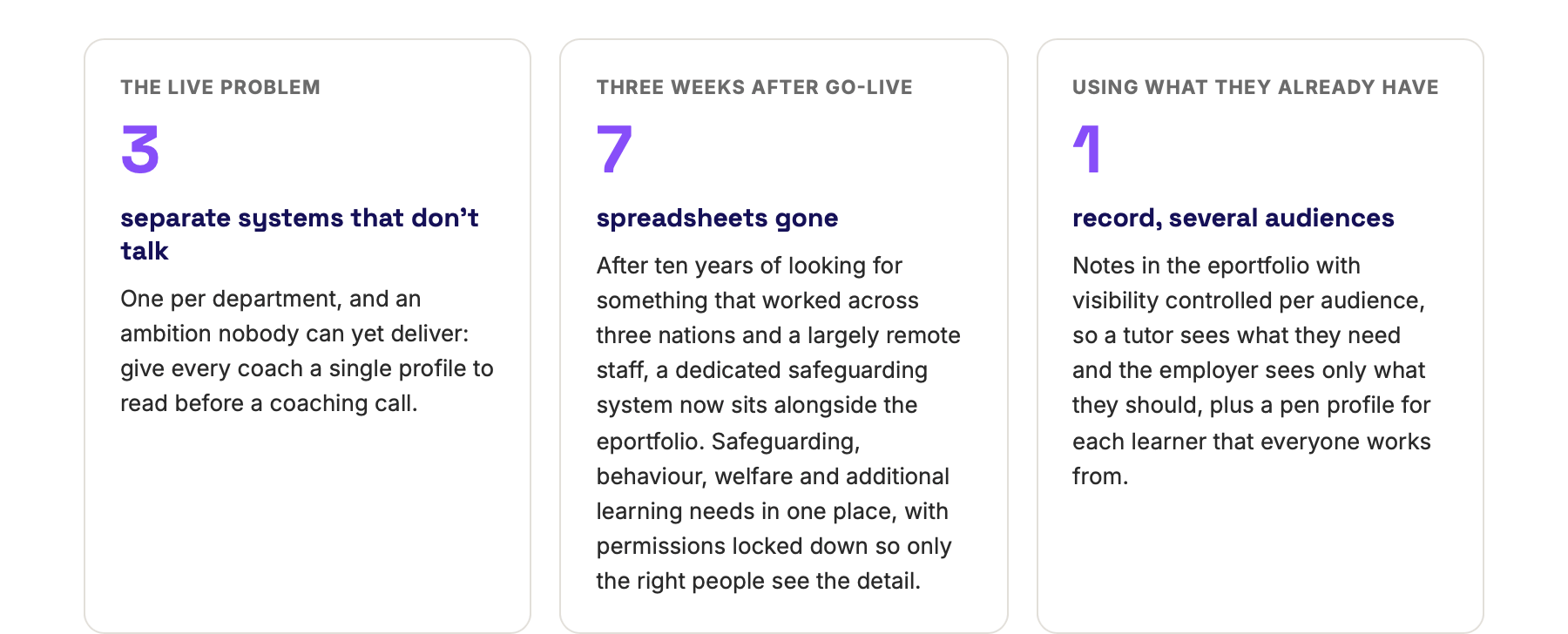

On the evidence question itself, Kelly's advice was to pair the data with learner and employer voice. Run pulse surveys, ask the uncomfortable questions, and be able to answer how you know something is working. One employer not knowing is survivable. Ten employers not knowing, with no survey data to say otherwise, is a finding.
1) Safeguarding and inclusion are two lenses on the same learner. Treating them as separate processes is what lets a learner slip between them.
2) Disclosure follows psychological safety. Learners share when they know what happens to the information, and when more than one person is a safe person to tell.
3) Every small observation builds a picture, but only if it lands somewhere everyone can see. Fragmented records are a safeguarding risk, not just an admin one.
What connected both scenarios was not policy. It was whether the people around a learner can see the same picture at the same time, and whether a learner believes that sharing something will make things better rather than worse. The first is partly a systems problem: information sitting in three places, permissions that are all or nothing, observations that never reach the person having the next conversation. The second is entirely human, and no platform will do it for you. What a platform can do is make sure that when someone finally does notice something, it is written down where it counts, visible to exactly the right people, and still there when it matters.
Book a discovery call to see how Onefile could support your organisation.

Onefile is the leading learner management platform that streamlines workflows, unlocks funding and enables education and training providers to achieve higher learner success rates, at pace and at scale.
Proud to be part of Harris Computer,
powering positive change.


© 2026 Onefile Ltd is registered in England with company number 4404879. The registered office is: 6th Floor, Cornerblock, Quay Street, Manchester, M3 3HN. VAT Number 792825685 © Onefile Ltd, 2005-2024. All Rights Reserved.