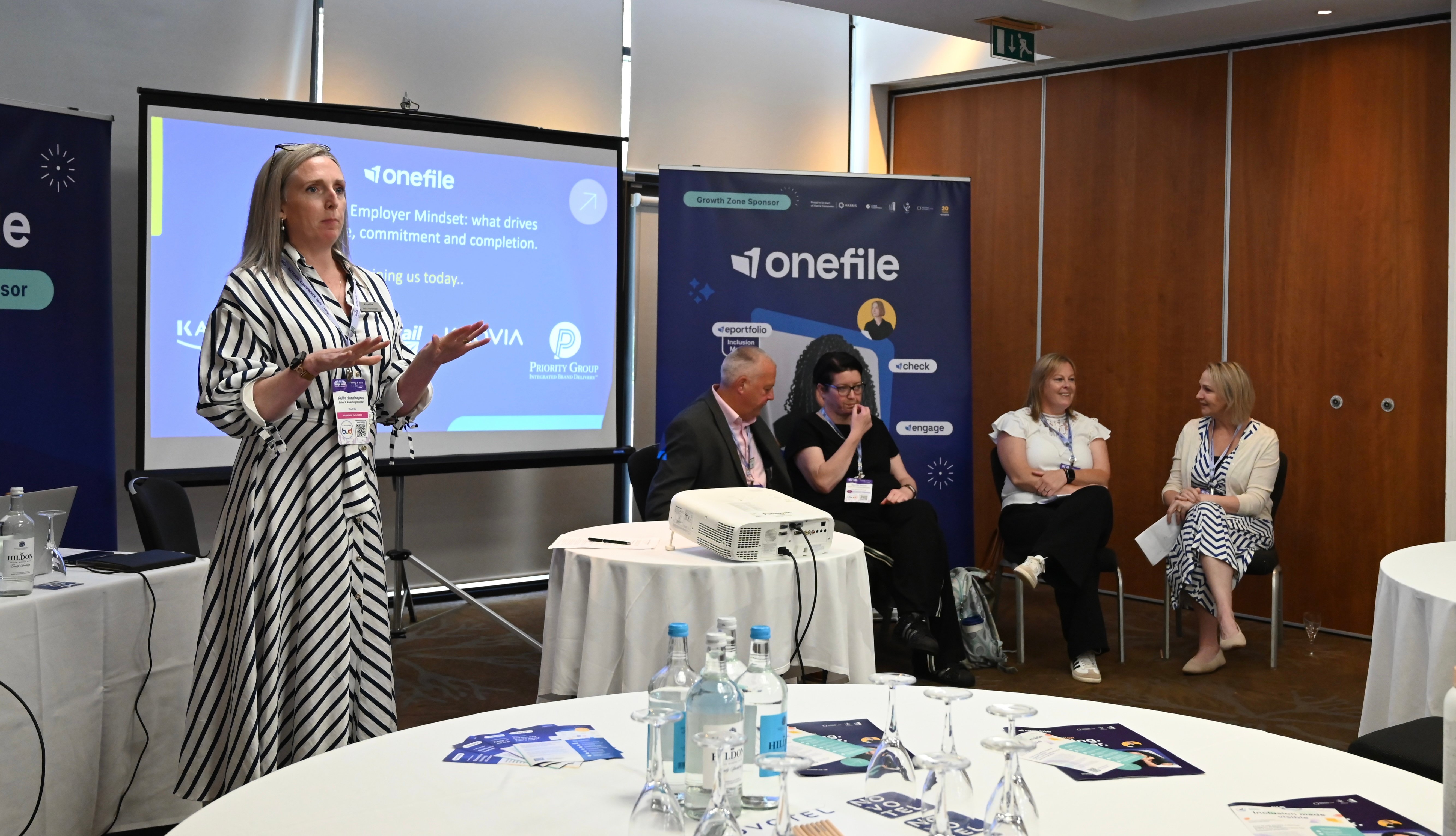
Hear from Kerrie Heath, Kerry Roberts, Ian Bamford and Jenny Pelling on Inside the Employer Mindset: What Drives Confidence, Commitment and Completion. The workshop Onefile hosted at the AELP National Conference 2026.
Chaired by Kelly Huntington, Director of Sales and Marketing at Onefile, the session brought employers and providers together to talk openly about what employers think about apprenticeships right now. Kelly opened with a simple question: on a scale from cautious to committed, where is employer confidence today? What followed was a candid conversation about funding uncertainty, the pivotal role of line managers, and why nobody celebrates success often enough.
The panel spoke from genuinely different vantage points. Kerrie Heath is a Career Development Specialist at Priory, the health and social care provider running roughly 750 apprentices on programme. Kerry Roberts manages apprenticeship and graduate programmes at Network Rail, recruiting around 500 apprentices a year. Ian Bamford is Chief Quality Officer at training provider Knovia, and also an Ofsted Inspector and Vice Chair of AELP. Jenny Pelling is Director of Strategy and Skills at Kaplan, which supports 10,000 apprentices from Level 2 to Level 7. Between them, two employers and two providers, the conversation covered the relationship from both sides.
Here is what the panel said, grouped around the three things every apprenticeship programme depends on.


Employer confidence today is best described as cautiously optimistic, and both employers on the panel used exactly that phrase. For Kerrie Heath, the optimism is grounded in stability: most of the standards Priory relies on are unaffected by the current reforms. The proof came when the Senior Leader apprenticeship was defunded and Priory chose to accelerate rather than pull back.
That confidence is not unique to one sector. Kerry Roberts sees the same steady demand at Network Rail: around 500 engineering apprentices recruited every year, clear visible impact, and a business that keeps asking for more. In both organisations the optimism comes from the upskilling opportunity, and the caution comes from never quite knowing what is next.
Employers with that kind of scale and infrastructure are the exception. Across the wider employer base, Ian Bamford described a picture of confusion. Incentives for recruiting under-25s are a minefield. Funding mechanisms do not always make sense to employers, and often do not cover the real cost of supporting a young person. Reforms move at wildly inconsistent speeds.
Underneath all of this sits a timing problem. Jenny Pelling pointed out that large employers plan their workforce 12 to 24 months ahead, so a letter arriving on a Monday about changes taking effect in September cannot fit a recruitment plan agreed years earlier.
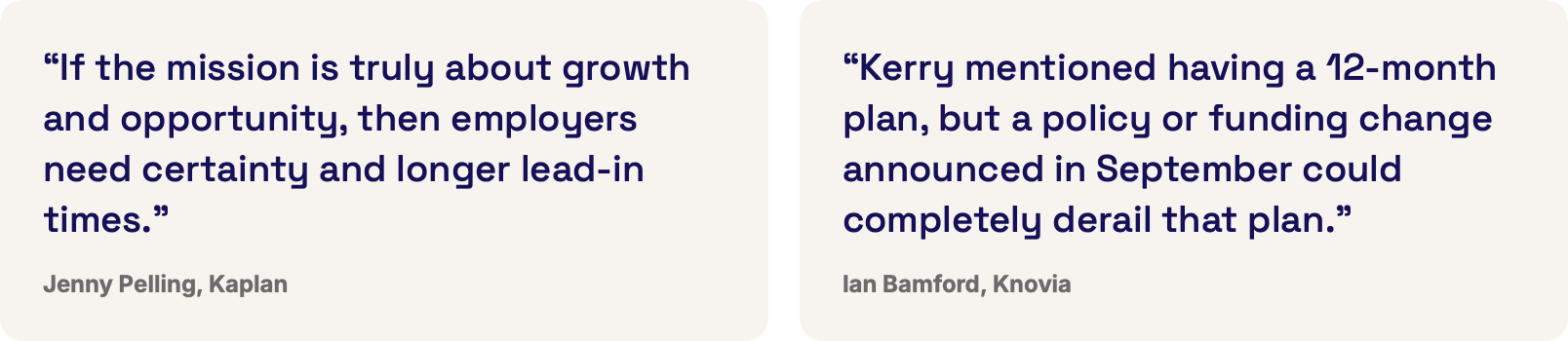
If confidence is shaped by policy, commitment is shaped much closer to home. It holds when problems surface early, and that depends on constant communication. Kerrie Heath described how Priory flags any concern the minute it appears, however minor. A RAG-based reporting system feeds a weekly meeting that might last ten minutes or half an hour, and her team then takes ownership with either the learner or their manager.
Behind that early warning sits one person. The single biggest variable is line manager engagement from day one. Kerry Roberts sees how easily a learner slips: they are busy, a project has landed, they will catch up later. A manager who understands why personal development matters is what stops that slide.
Expecting that engagement without giving managers support is unrealistic, as Ian Bamford pointed out. A line manager's job is not apprenticeships; in a care home they are running day-to-day operations and managing staff. Education has to run in both directions, so managers know what providers expect of them and providers understand the environment managers work in.

Priory found that the way an apprenticeship is framed changes how seriously it is taken. Because the cost does not come out of a manager's budget, some managers treated it as free training and stayed relaxed when a learner hits a hurdle. Changing the language changed the response.
That one shift has been among the biggest factors in reducing drop-off.
Commitment gets a learner through the middle of a programme. Getting them over the line takes something less comfortable, because kindness itself can be a risk to completion. Ian Bamford warned that tutors can be too caring: don't worry, we'll pick it up next month. Then the same thing happens again, and the learner is three months behind and starting to believe they will never finish.
Handled the other way, the numbers look very different. When Kerry Roberts took on the Transport Passenger Operations apprenticeship there were no timely completions at all. Working closely with management teams, and using the strongest line managers as advocates, changed the picture entirely.

What separates the two is rarely process. Asked for the most underrated thing a provider can do, the panel talked about human understanding. Kerrie Heath asked providers to learn the employer's own policies as well as their own. When a tutor noticed a learner showing signs of distress and raised it, even though the learner would not talk, she was able to go to a manager who already had context.
That understanding extends to how programmes are run day to day. Kerry Roberts asked for realism about reactive environments, where a tripartite review can clash with something urgent and rescheduling is simply the sensible answer. Jenny Pelling then named an omission the whole panel recognised: People are often too busy managing challenges and supporting struggling learners that we forget to share the good news.
And those stories travel further than expected. Senior leaders are often more disconnected from them than anyone realises. Kerry Roberts shared how she has been talking to the CFO about specific apprenticeship successes. As Jenny Pelling put it, CEOs, CFOs and line managers all remember the individual who made a difference.
Kelly Huntington closed on the point that ties all three themes together: we tend to save success stories for National Apprenticeship Week, when recognition should be happening all year round.
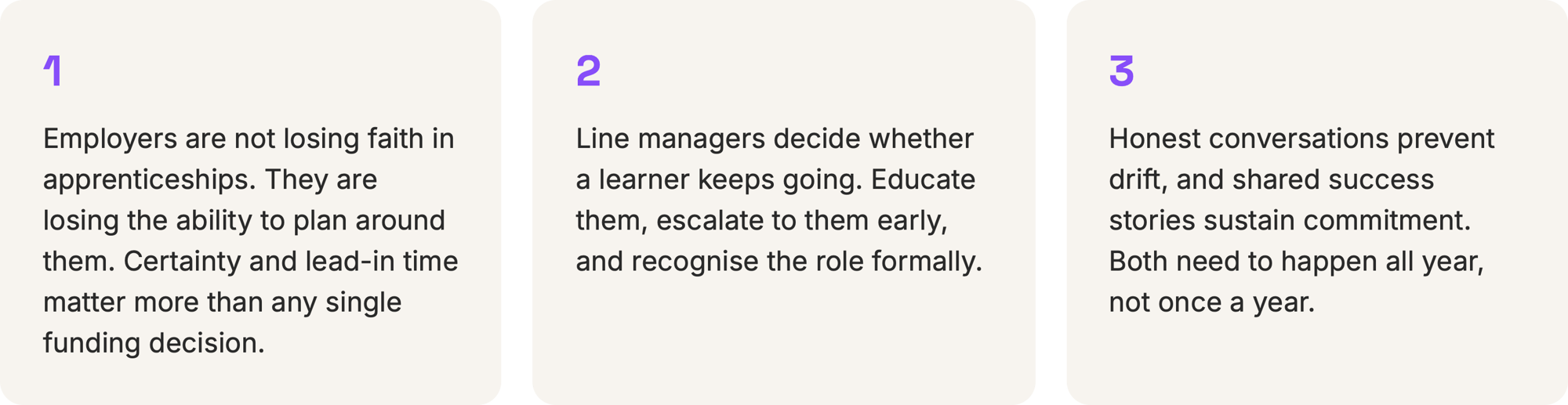
What comes through across all three sections is that none of this is really a technology problem. It is a visibility and communication problem, and providers and employers are trying to solve it under funding pressure and shrinking lead-in times. But visibility is where the right tools do help: surfacing a dip before it becomes a crisis, giving a line manager an honest view of progress without expecting them to become an apprenticeships expert, and making it easy to spot and share a success story instead of losing it in an inbox. That is the space Onefile works in, and it is why conversations like this one shape what we build.


Onefile is the leading learner management platform that streamlines workflows, unlocks funding and enables education and training providers to achieve higher learner success rates, at pace and at scale.
Proud to be part of Harris Computer,
powering positive change.

.jpg?width=369&height=160&name=soc-ci-ukas-h-iso-9001-isoiec-27001-rgb-ezgif.com-small(3).jpg)
© 2026 Onefile Ltd is registered in England with company number 4404879. The registered office is: 6th Floor, Cornerblock, Quay Street, Manchester, M3 3HN. VAT Number 792825685 © Onefile Ltd, 2005-2024. All Rights Reserved.




-png-1.png?width=183&height=85&name=socotec-certification-mark_iso-9001-iso-iec-27001-ukas_cmyk-en%20(1)-png-1.png)